India’s United Payments Interface (UPI) continues to dominate the payments landscape, growing at a relentless pace. Despite efforts by new players entering the market, concerns are emerging that UPI might be crowding out other payment modes—such as credit cards—which could potentially stifle innovation and limit consumer choice.
Other Payment Methods Are Slipping
Just over a decade old, UPI has garnered nearly half a billion users. In Q3 2025, it processed 59.3 billion transactions, up from approximately 44.4 billion in the same period of 2024. UPI has also surpassed Visa to become the world’s largest real-time payments system, with around 640 million transactions per day compared to Visa’s 639 million.
The strongest growth comes from merchant payments, which increased by 35% year over year to 37.46 billion transactions. Peer-to-peer transactions also expanded, growing by 29% over the same period.
Other Payment Methods Are Slipping
Amid UPI’s rise, other payment rails have struggled. Transactions on RuPay, operated by the National Payments Corporation of India (NPCI), have been declining steadily. In 2023, RuPay processed 1.2 billion transactions, but this fell to 938 million in 2024 and further reduced to around 664 million by November 2025.
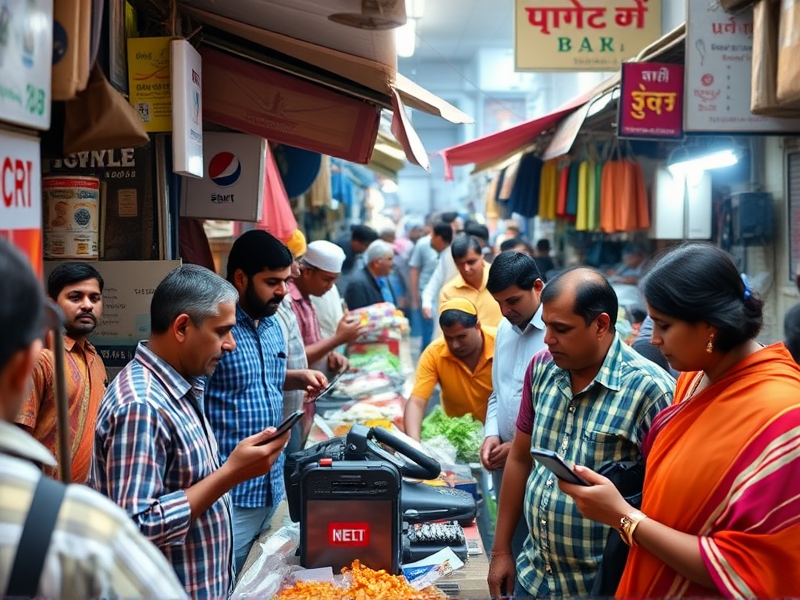
UPI’s QR code payments are increasingly taking share from card swipes, once the dominant form of digital payment in India. Active UPI QR codes grew by 21% over the past year, replacing traditional card-swiping machines and bringing millions of small merchants into the digital ecosystem.
Credit Card Growth May Be Slowing
Despite India’s large population of more than 1.4 billion, fewer than 50 million people hold credit cards, indicating strong potential for growth. Even so, the momentum appears to be slowing. According to data from CareEdge, credit card spending in India rose by 23% year over year in September 2025, down slightly from the 24% growth recorded in September 2024.
Decrease in Debit Card Usage
Debit card usage has also fallen sharply. As reported by the Reserve Bank of India (RBI), debit card transactions declined from about 5 million in 2019 to roughly 1.7 million in 2024.
New Competitors Enter the Market
Competitors are still trying to penetrate the market. Google Pay, for instance, has introduced its own digital credit card called Flex, while staying deeply integrated with UPI, which processed about 7.2 billion UPI transactions in October.
Similarly, IndiGo, India’s largest domestic airline, launched a co-branded credit card tied to its loyalty program through partnerships with Kotak Mahindra Bank and IDFC First Bank, becoming the first major Indian airline to do so.
Better Options for Merchants
The Immediate Payment System (IMPS), an inter-bank fund transfer mechanism in India, is also losing ground, with transactions falling to 368 million in November from 407 million a year earlier.
UPI is growing and taking transaction volume away from the legacy IMPS network due to its better user interface,” according to Don Apgar, Director of Merchant Payments at Javelin Strategy & Research. More importantly, UPI is free for merchants right now, meaning there are no merchant discount fees. Merchants are likely to actively promote UPI as their preferred payment option for customers.”
Government Support for UPI
The Indian government has pushed UPI adoption over the past decade, maintaining low or nonexistent merchant costs. It considered offering consumer incentives such as discounts for paying via UPI instead of credit cards, which typically carry a 2% merchant fee.
RBI announced plans to raise UPI transaction limits, opening the system to more business-to-business payments. Previously, merchant transactions were capped at around $1,162, requiring users to split larger purchases or switch to alternative payment methods. Recently, NPCI was granted authority to lift limits on both person-to-person and merchant UPI payments.
The question now is how long the RBI will continue subsidizing UPI during its growth phase. The central bank of India is still subsidizing UPI through this growth phase,” Apgar said. Local payments experts acknowledge that isn’t sustainable, and a merchant discount fee might become part of UPI at some point.”